
In being able to trace the development of a language, this means we can also trace the evolution of certain ideas, or the introduction of new words from outside cultural or religious influences. In particular, with the arrival of Christianity – where an understanding of Latin was essential in the early Church – we start to see the introduction of certain words into the Irish language that were derived from a Latinate, Christian context. In other cases, we start to find the meaning of certain words began to change, under this new, Christian influence, which may have allowed pre-Christian concepts to be reframed into a more acceptably Christian context. In doing so, we find that some of these pre-Christian beliefs and ideas were able to survive for far longer than they otherwise would have. Sometimes, however, the words were eventually replaced by more acceptably Christian terms; in the rest of this section we’ll look at a few examples to illustrate our point, and show how this could impact our own practices.
The arrival and eventual domination of Christianity obviously brought radical changes with it – not just in terms of religion, but cultural, societal ones, too. In some respects, Christian beliefs were very different to the pre-Christian beliefs those first converts had been raised with (although there were certainly areas of overlap). In particular, the Bible taught a dualistic understanding of the world, dividing it into two spheres – heaven and earth – which were separate and distinct from one another. The evidence suggests that the pre-Christian people of Ireland saw things differently, however, and instead of heaven and earth the world was divided into the three realms of land, sea, and sky. While Christians might (traditionally) swear on God, Jesus, or the Bible, we see the pre-Christian Irish were supposed to have sworn by the gods ‘their people swear by,’ or else they swore by the land, sea, and sky, and by the elements (or dúile) that occupied those three realms. There was a very real belief that should that oath be broken, the elements or the three realms themselves might rise up and exact a terrible punishment; a natural consequence of having proved oneself false.
Some of these pre-Christian ideas were pretty tenacious, and we can see this from the way in which certain things are expressed, the way in which blessings are given, oaths are made, or even in the way poetry was composed. Pagan and Christian elements blended into a distinctively Irish expression, although of course what we might argue as ‘pagan’ elements weren’t consciously thought of in that way at the time: they were just how things were done – how things had always been done. It was just ‘tradition.’
An example here is this oath:
Rotbia lim greim Dé fodéin,
rotbia m’ordan co glanléir,
grían ocus ésca ’mole,
muir is tír, drúcht is daithe.
You will have from me God’s own grip.
You will have my honour bright,
the sun and the moon as well,
sea and land, dew and light.29
To all intents and purposes it might look like there’s only a ‘thin veneer’ of Christianity that’s been slapped on at the beginning, but that’s not really the case, is it? It may also articulate sentiments that are pre-Christian at their core, but that doesn’t mean people were only paying lip-service to Christianity. They were simply expressing themselves in the best way they knew how. Why should that change, especially when oaths were simply being sworn on God’s own creation? The ‘pagan’ became ‘tradition,’ which allowed it to be reframed in a more suitably Christian context.
At times, this mish-mash of Christian and pagan crops up in unexpected places. In Irish retellings of the Genesis story from the Bible, for example, we sometimes see references to the three realms – talam (‘land’), muir (‘sea’), and nem (‘sky’) – where the original story references heaven and earth. It wouldn’t be unreasonable to assume that the Irish author should have described God creating heaven and earth, but instead we find that he chose to stick with a ‘native’ expression of the world around them. Again, it’s not because these scribes were secretly pagan and were trying to stick it to the Church in the only way they knew how (safely), or anything like that, but (probably) because it was simply something that made more sense to them; if the idea was so entrenched in the culture of the time, the scribe may not even have given it a second thought. In fact, this idea of the three realms was so well-entrenched that the realm of nem (‘sky’) quickly came be understood in more traditionally Christian terms, by gaining an additional meaning of referring to ‘heaven,’30 perhaps as a way of framing the three realms in a more acceptable manner.
While some words (like nem) were being revised and reframed, taking on new meanings, we can also see new words being adopted into Irish, to reflect Christian sentiments and to create or reflect a liturgy that was more in keeping with the Church as a whole. The word for ‘blessing,’ (Old Irish bennacht) is one example here, being derived from the Latin benedictum. 31 Most people today wouldn’t give it a second thought, but the addition of a word like this is quite a radical change; before Christianity came along the pre-Christian Irish expressed their blessings in a different way, and we might find evidence of how they did this in the very earliest poems that have survived.
For the most part, these early poems date to around the seventh or eighth century or so – at a time when society was still in the process of transitioning from pagan to Christian (though admittedly the bulk of the work had already been done by this point). A poem praising a king of Leinster, named Áed mac Diarmata meic Muiredaich († c. 750) has the line:
Ind flaith issed a orbbae · cach maith do dé no [anddae]
The lordship, this is his heritage, every good to him of gods or ungods.32
Instead of a blessing (bennacht), then, the poet wishes ‘every good’ to Áed – not only that, but he specifically invokes the ‘gods and ungods,’ which is very obviously not an especially Christian sentiment whichever way you want to slice it. The blessing of ‘gods and ungods’ can’t really be argued as mere ‘tradition’ like we could with the three realms, because the very concept flies in the face of Christianity, directly contradicting its basic, fundamental principles (not to mention one of the ten commandments).
These ‘gods and un-gods’ are mentioned elsewhere, too – in the Táin, where it’s again mentioned as part of a blessing (but this time using the Latin-derived bennacht):
Bendacht dee & andee fort, a ingen.
“A blessing on thee of gods and of non-gods, O woman!”33
This is a blessing that’s given to the Morrígan by Cú Chulainn, after the Morrígan has tricked him into giving it so that he might heal the wounds he inflicted upon her earlier. Cú Chulainn and the Morrígan have a rather antagonistic relationship in the tale, and Cú Chulainn wouldn’t have (willingly) helped her otherwise. Despite the use of a Latin loanword, expressing this idea of a ‘blessing,’ it’s been suggested that this episode – the formula that’s specifically used in the blessing – may represent a memory of a genuine, pre-Christian healing ritual.34
The gods and un-gods are mentioned in other contexts, too – not just in blessings, but as a general ‘thing’ that exists. In a ninth century tale, called Scél Túain meic Chairill (‘The Tidings of Túan mac Cairill’), for example, the gods themselves are referred to as the Tuatha Dé ocus Andé (‘Peoples of the Gods and Un-gods’) at one point in the text.35 In the period this tale was written down, the gods hadn’t yet been given the name they’re best known by now – the Tuatha Dé Danann (‘Peoples of the Goddess Danu’). As far as anyone can tell, this didn’t happen until the very late tenth century, or possibly the early eleventh century, when the Lebor Gabála Érenn (‘Book of Invasions’) was undergoing a major overhaul. The Book of Invasions makes the connection between the gods and un-gods and the Tuatha Dé Danann crystal clear, insisting that:
Those are the Tuatha Dea – gods were their men of arts, non-gods their husbandmen. They knew the incantations of druids, and charioteers, and trappers, and cupbearers.36
Although this is meant to help explain the nature of the gods, however, it doesn’t really clear much of anything up, does it? The one thing that is clear, perhaps, is that the phrasing – of ‘gods’ and ‘un-gods’ – is obviously very old, and it’s very possibly pre-Christian in origin. Again, then, while the meaning of the phrase isn’t well understood, it tells us something about how the gods may have been perceived.
Because it may be seen as a more ‘authentic’ way of referring to the gods, some Gaelic Polytheists have attempted to adapt the phrase into a modern language (usually Irish). There are some problems with this, though, because of the way the languages have evolved over time. Where the early form of andée (‘un-gods,’ pronounced: an-jay) seems to have carried a fairly neutral meaning – it doesn’t seem to have been intended to suggest anything inherently negative about the nature of the un-gods – a modern rendering of the term, in Irish or Gaelic, most certainly does. Where the Old Irish dée becomes déithe (‘gods,’ pronounced jay-huh) in modern Irish, andée becomes aindéithe (pronounced: an-jay-huh). The singular form of aindéithe, however, is aindia (pron: an-jee-uh), which translates to mean ‘false gods’ – not ‘un-gods.’37 Something similar happens in Gaelic, too. Where dée can be expressed as diathan (pron: jee-a-han) or dée (or déidh; both pron: jay), our Old Irish andée would become ain-diathan (ain-dée or ain-déidh). Again, though, the ain- prefix has developed negative connotations. Ain-spiorad, for example, means ‘evil spirit,’38 and so ain-diathan could be viewed in similarly ‘evil’ terms that were never meant to have been suggested here (as far as we can tell).
In either case these aren’t the kinds of meanings we really want to convey or even potentially hint at, and so there’s a question of whether modernising these terms is really possible (or a good idea). We can claim a clear and historical precedent for these modern forms – they’re not being pulled out of thin air, after all – but if words like this are to be understood in the way we want them to be understood, we can’t force that change or insist on an interpretation that doesn’t come naturally anymore, just for the sake of our own convenience. That’s something that has to come from within the language communities as a whole.
Beyond the issues with modernising this phrase, we don’t actually know what it means – we can offer some guesses, but there’s not, as yet, any real consensus here (if there ever will be). One possible explanation for the meaning of dée ocus andée is that the phrase refers to the gods and spirits of Gaelic tradition, who both live in the síde (pronounced: shee-thuh – the th as in seethe or breathe) or otherworldly hills and mounds (often prehistoric burial monuments that were built in the Neolithic or Bronze Age). There’s a huge overlap between the gods and spirits (or ‘fairies’) because the myths and legends suggest that the gods were displaced by the ancestors of the Irish people (the Milesians), who won Ireland for themselves. After the Milesians conquered Ireland, the gods retreated underground – into the síde – where they promised to keep the peace with their new upstairs neighbours.
In some versions of this story we’re told that the gods went to live with the spirits in these síde (meaning these otherworldly homes already existed), while in other stories it’s suggested that the gods built the síde themselves and then they eventually just ‘became’ the fairies (or, more to the point, they had always been fairies but the truth was only acknowledged later on; if you’re Christian there is obviously only one God, so they can’t ever have been true gods in their own right, ergo they were fairies all along and were just mistaken for gods by people who didn’t know any better, until Jesus came along and show the world the truth).
Whatever actually happened, it’s clear there aren’t very distinct boundaries between the gods and spirits (or fairies). They kind of blend into one another, and this is something that’s made very clear from the way in which both groups might be called the áes síde (pronounced ice sheeth-uh; Old Irish for ‘the people of the fairy mounds’), or – in more modern sources, the aos sí (pronounced eez shee; same meaning).
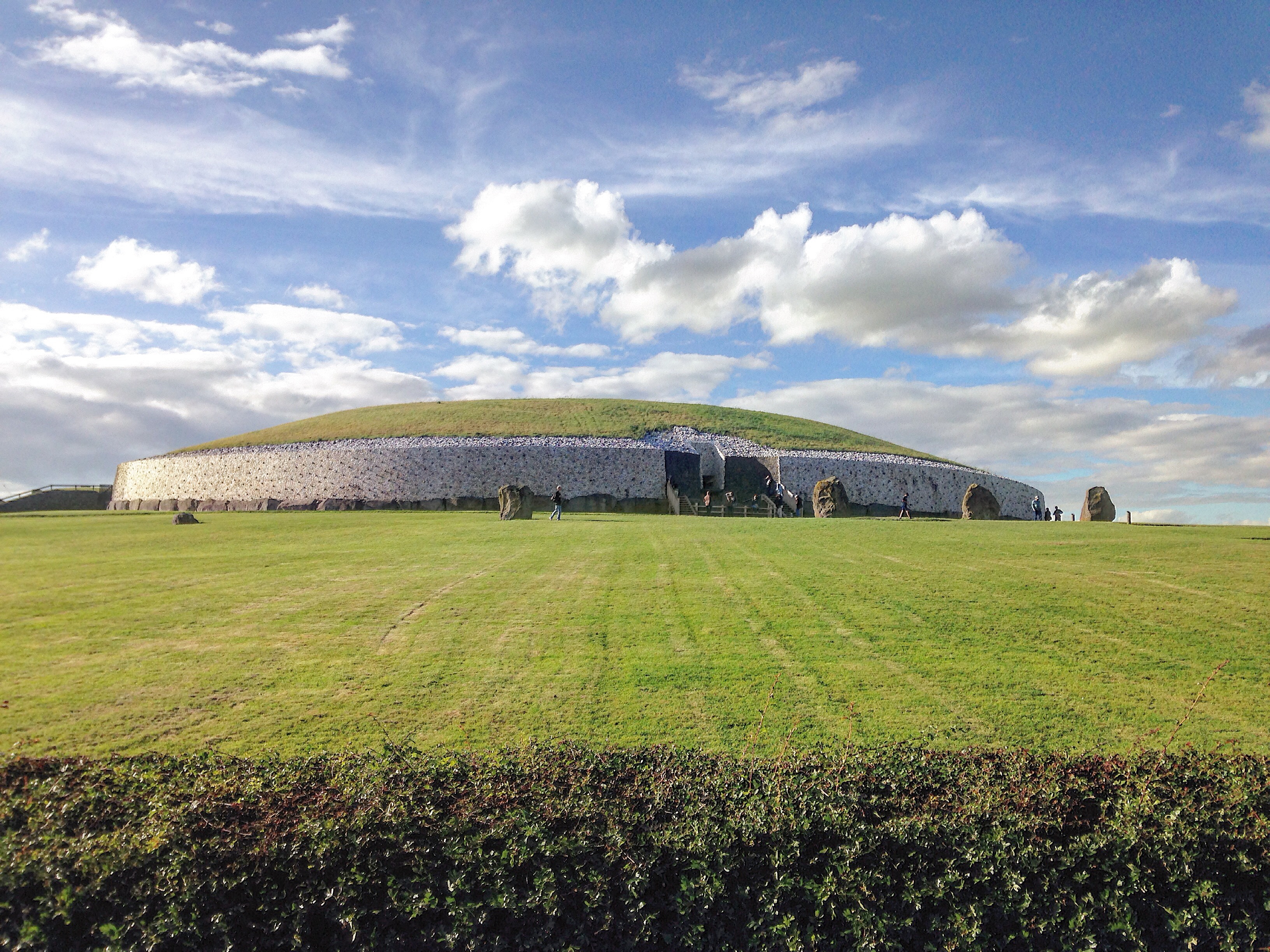
No matter who’s described as living in these síde, however, the stories show us that mere mortals might sometimes be able to go inside them. According to the Annals of Tigernach, for example, a figure by the name of Giolla Lugan (generally presumed to have been a poet), ‘used to haunt the síd every year at Samain.’ During one of these visits, the annal entry goes on to say, Óengus mac Ind Óc told Giolla Lugan of a plague that was coming to Ireland in the year 1084, and Óengus was gracious enough to explain to Giolla Lugan the cause of the great pestilence – ‘namely, demons that came out of the northern isles of the world, that is, three battalions, and in each battalion there were three thousand in each battalion… and wherever their heat and fury reached, it is there that their venom assailed. For there was a sword of fire out of the gullet of each of them, and every one of them was as high as the clouds of heaven, so that is the cause of this pestilence.’39
In these otherworldly homes, mortal visitors will often find a peaceful idyll. There is no death or hunger, no struggles or want. If it’s winter in the ‘real’ world – this world – then it’s summer in the otherworld, and the weather is defined by whatever ideal or stereotype we might associate with the season; the otherworld’s summer is defined by bright sunshine and comfortable warmth, with bees lazily buzzing around, and flowers waving gently in a cool breeze. Its winter, meanwhile, is marked by a blanket of snow, conveniently allowing the mortal visitor to bring back incontrovertible proof of where they’ve been – snow or flowers out of season.40
If we look at the word for these otherworldly homes in more depth, from a linguistic point of view, we can see that the otherworldly nature of the place, and the peaceful conditions that are so clearly described in the tales, are both encapsulated in the meaning of síd (the singular form of síde; pronounced shee-th (s.), again rhyming with seethe) itself. Síd can mean ‘a fairy hill or mound,’ but it can also suggest a meaning of ‘peace, good will,’41 and as Tomás Ó Cathasaigh has pointed out these two meanings are semantically linked – they come from the same linguistic root, which is very probably not a coincidence.
This suggests to us that the two concepts have always been tied to one another, and so the location and the condition of the otherworldly síde is something that’s integral to the word itself. As such, it probably always has been. In fact, Ó Cathasaigh goes so far as to suggest that the word may have undergone ‘progressive specialization of meaning, narrowing from abode in general to abode of the gods in particular, and then from abode of the gods in general to hollow hill in particular.’42 As such, it’s reasonable to suppose that the medieval tales that describe these peaceful, otherworldly are describing a genuinely pre-Christian belief.
The name of Lugnasad (Old Irish spelling, pronounced lug-nass-ad), the festival marking the end of summer and the beginning of autumn in the Gaelic calendar, derives from Lug – the god – and násad (‘assembly’), so it means ‘assembly of Lug.’ As tradition has it, the festival is said to have been instituted by Lug as a funeral games in honour of his foster-mother, Tailltiu, who was buried at Teltown (which takes its name from her). The funeral games were held each year at her burial site, with people from all around the area gathering together. The evidence suggests that this story is just one explanation of the festivals origins – there are assembly sites like this all over Ireland, and a number of them are said to be the burial sites of women who are somehow related to Lug, as well (usually his wives). The consistent, recurring association between Lug, a female figure who’s being commemorated by Lug, and the assembly sites where these festivals were held, suggests that these explanations really do point to a pre-Christian tradition, with Lug himself presiding.43
References
29 See Dennis King’s Sengoidelc website.
30 Liam Mac Mathúna, ‘Irish perceptions of the cosmos,’ in Celtica 23 (1999), 181; 185.
31 http://edil.qub.ac.uk/5661 See: Rudolph Thurneysen, A Grammar of Old Irish trans. D. A. Binchy and O. Bergin (1946), 450.
32 Whitley Stokes and John Strachan, Thesaurus Paleohibernicus Volume II (1901), 295.
33 The Táin.
34 D. Rankin, ‘Bendacht dee & andee fort, a ingen (Táin Bó Cúalgne 2111, O’Rahilly),’ in Zeitschrift für Celtische Philologie 51 (1999), 118.
35 See: John Carey, ‘Scél Túain meic Chairill,’ in Ériu 35 (1984).
36 The Book of Invasions. For a discussion of the name ‘Tuatha Dé Danann’ and the evidence for its first attested use (and possible meaning) in the literature, see John Carey’s ‘The Name Tuatha Dé Danann,’ in Éigse 18:2 (1981).
37 See: https://www.teanglann.ie/en/fgb/aindia
38 For the declension of dia, ‘god,’ see: https://www.dwelly.info/ViewDictionaryEntry.aspx?ID=DE683D02DD6E0130643649F04016EC16 For ain-dia see: https://www.dwelly.info/ViewDictionaryEntry.aspx?ID=A6F78C85C61A7140D197A3A9E63555D3 There is also ann-spiorad, but that carries a negative meaning as well: https://www.dwelly.info/ViewEntry.aspx?ID=628A24EB93647F1C2172FDDA0450CAEE
39Annals of Tigernach, 416.
40 This motif is especially prominent in the story of Echtra Nerai (‘The Adventures of Nera’).
41 See: http://edil.qub.ac.uk/37441 and http://edil.qub.ac.uk/37442
42 See Tomás Ó Cathasaigh’s ‘The Semantics of Síd,’ which was originally published in Éigse 17:2 (1978), and more recently reprinted in a compilation of Ó Cathasaigh’s articles, by Matthieu Boyd (Ed.). See Coire Sois: The Cauldron of Knowledge – A Companion to Early Irish Saga (2014). John Shaw also touches on the subject in his article on ‘Fashioner Gods in Ireland and India: the Dagda and Tvastr,’ in Emily Lyle (Ed.), Celtic Myth in the 21st Century: The Gods and Their Stories in a Global Perspective (2018), 159.
43 See Máire MacNéill’s The Festival of Lughnasa: A Study of the Celtic Festival of the Beginning of the Harvest (1962; repr. 2008).
44 Eric Hamp’s ‘The Dag(h)d(h)ae and his relatives,’ in L. Sawicki and D. Shalev (Eds.), Donum grammaticum: Studies in Latin and Celtic Linguistics in Honour of Hannah Rosén (2002), 168. For the Dagda as a soubriquet, and his other names, see: John Shaw, ‘The Dagda, Thor and ATU 1148B: Analogues, Parallels,or Correspondences?’ in Temenos 55:1 (2019), and John Shaw, ‘Fashioner Gods in Ireland and India: the Dagda and Tvastr,’ in Emily Lyle (Ed.), Celtic Myth in the 21st Century: The Gods and Their Stories in a Global Perspective (2018).
 Eòlas
Eòlas 
